III Domingo del Tiempo Ordinario (a)

Definitivamente no nos gusta mucho hablar de conversión y el evangelio de hoy habla de ella. Casi instintivamente, pensamos en algo triste, penoso, muy unido a la penitencia, la mortificación y el ascetismo. Un esfuerzo casi imposible para el que no nos sentimos ya con humor ni con fuerzas.

Pero, si nos detenemos ante el mensaje de Jesús en el evangelio de éste domingo escuchamos, antes que nada, una llamada alentadora para cambiar nuestro corazón y aprender a vivir de una manera más humana, porque Dios está cerca y quiere poner nueva vida en nuestra vida. La conversión de la que habla Jesús no es algo forzado, es en realidad un cambio que va creciendo en nosotros en la medida en que vamos cayendo en la cuenta de que Dios es alguien que quiere hacer nuestra vida más humana y feliz[1].

Porque, convertirse no es, antes que nada, intentar hacer desde ahora todo «mejor», sino sabernos encontrar con ese Dios que nos quiere mejores y más humanos. Un encuentro personal. No se trata sólo de «hacerse buena persona» sino de volver a aquél que es bueno con nosotros. Por eso, la conversión no es algo triste sino el descubrimiento de la verdadera alegría. No es dejar de vivir sino sentirse más vivo que nunca. Descubrir hacia dónde debemos vivir. Comenzar a intuir todo lo que significa vivir.

Convertirse es algo gozoso. Es limpiar nuestra mente de egoísmos e intereses que empequeñecen nuestro vivir cotidiano. Liberar el corazón de angustias y complicaciones creadas por nuestro afán de dominio y posesión. Liberarnos de objetos que no necesitamos y vivir para personas que nos necesitan.

Uno comienza a convertirse, cuando descubre que lo importante no es preguntarse: «¿cómo puedo ganar más dinero?», sino «¿cómo puedo ser más humano?». No «¿cómo puedo llegar a conseguir algo?» sino «¿cómo puedo llegar a ser yo mismo?». Cuando uno se va convirtiendo a ese Dios del que nos habla Jesús, sabe que no ha de temerse a sí mismo ni tener miedo de sus zonas más oscuras. Hay un Dios a quien nos podemos acercar tal como somos.

Si, al pasar los años, no nos hemos encontrado nunca con este Dios, podremos llegar a ser algo importante, pero habremos equivocado el sentido de nuestra vida.

Cuando hoy escuchemos la llamada de Jesús: Convertíos porque está cerca el Reino de Dios, pensemos que nunca es tarde para convertirse, porque nunca es tarde para amar, nunca es tarde para ser más feliz, nunca es demasiado tarde para dejarse perdonar y renovar por Dios ■


[1] Cfr. J. A. Pagola, Buenas Noticias, Navarra, 1985, Pág. 67 s.

VISUAL THEOLOGY


Plaque with the Baptism of Jesus,  South Netherlandish, Meuse valley, Made about 1150–75, The Metropolitan Museum of Art, New York. 

Third Sunday in Ordinary Time (a)

Today’s readings begin with the passage from Isaiah that we proclaim at the Christmas Midnight Mass: the people who walked in darkness have seen a great light[1], and the Gospel repeats this reading, but immediately adds, From that moment Jesus began his preaching[2].

I was thinking about how this passage relates to our young people living in a world where at times they have to struggle to survive.

There is certainly a great deal of darkness in our world. We all run into people who are liars and cheats. Their selfishness affects us all. There are people who keep the world in darkness because they are users, particularly in the area of love, or for them, basically, the area of lust. I hope and pray that this has never happens to any of you who read this no matter what your age, but the fact is that there are people who say, “I love you,” but who do not have the slightest clue as to what love is. These are the people who jump out of a relationship, run from it, when they realize they have to sacrifice themselves for the relationship. For them the crucifix is a piece of jewelry, not a reminder of how a Christian loves. That person who used you by saying, “I love you,” and then dumped you or forced you to dump him or her when you said, “No,” is the same person who will run from a marriage when the commitment is too demanding, or, sometimes, demanding in any way at all.

I can go on and on with the negatives, but bring them up to emphasize this point: We are not these people. We are not the people of darkness. We are people of light. We are not condemned to live as liars, cheats or users, or whatever. We have seen a great light.

Sometimes a person will say to me, “I don’t know what to do. Should I just keep going out with him or her or should I break up? I’m in the dark here.”
No, you are not in the dark. Nor am I. We are not the people living in the land of shadows. We are the people of light. We have been enlightened by Christ. We have to base our decisions on the Light of Christ that glows within us. He comes into our lives, and He changes our lives in such a fundamental way that we have no choice but to bring His light to others.

“I don’t know what to do.” Sure you do. Do that which adds light to the world, not that which is just part of its darkness. Sure, it may hurt to break a relationship that is going bad. No matter how much any decision might cost us, we will always be happy with ourselves when our choices are determined by the Light of the Lord.

Have you ever seen the stars on a clear night when you are far away in some remote place? Well, once yours eyes adjust, we realize that so many stars fill the sky that it seems to be on fire. It is wonderful. It might be night around us, but we are not in the dark. We are in starlight. Here is another stellar reality: We are the stars in God’s sky, every one of us. And just as each star shines light on the world, every one of us is necessary to illumine the world with His Light.

Each one of us is not just one of billions of people. Each of us is special. We have the same value of the blood of Christ. Every single one of us is a star. We have been called by Christ personally to enlighten the world. If we live in His Light, we will bring His Light to others.

I want to conclude with simple maxim from Blessed Mother Theresa of Calcutta: “Love Jesus, Live with Jesus, and you will live for Jesus.”


[1] 9:2.
[2] Sunday 23rd January, 2011, 3rd Sunday in Ordinary Time. Ss TIMOTHY & TITUS. Readings: Isaiah 8:23 – 9:3. The Lord is my light and my salvation. Ps 26(27):1, 4, 13-14. 1 Corinthians 1:10-13, 17. Matthew 4:12-23.


Jesu, dulcis memoria,
dans vera cordis gaudia:
sed super mel et omnia
ejus dulcis praesentia.
Nil canitur suavius,
nil auditur jucundius,
nil cogitatur dulcius,
quam Jesus Dei Filius.
Jesu, spes paenitentibus,
quam pius es petentibus!
quam bonus te quaerentibus!
sed quid invenientibus?
Nec lingua valet dicere,
nec littera exprimere:
expertus potest credere,
quid sit Jesum diligere.
Sis, Jesu, nostrum gaudium,
qui es futurum praemium:
sit nostra in te gloria,
per cuncta semper saecula.
Amen 
...
Oh Jesús de dulcísima memoria,
Que nos das la alegría verdadera:
Más dulce que la miel y toda cosa
Es para nuestras almas tu presencia.

Nada tan suave para ser cantado,
Nada tan grato para ser oído,
Nada tan dulce para ser pensado
Como Jesús, el Hijo del Altísimo.

Tú que eres esperanza del que sufre,
Tú que eres tierno con el que te ruega,
Tú que eres bueno con el que te busca:
¿Qué no serás con el que al fin te encuentra?

No hay lengua que en verdad pueda decirlo
Ni letra que en verdad pueda expresarlo:
Tan sólo quien su amor experimenta
Es capaz de saber lo que es amarlo.

Sé nuestro regocijo de este día,
Tú que serás nuestro futuro premio,
Y haz que sólo se cifre nuestra gloria
En la tuya sin límite y sin tiempo 

II Domingo del Tiempo Ordinario (a)


En el evangelio de hoy, vemos cómo Juan el Bautista presenta a Jesús al pueblo de Israel señalándolo como el Cordero de Dios que quita el pecado del mundo. Aquel hombre –perfecto Dios también y al mismo tiempo aunque los espectadores no lo sepan- sobre quien se ha posado el Espíritu, es el Hijo de Dios. Sin duda es una buena presentación para aquel tiempo y para los judíos. Pero, hoy la era del facebook y los ipod ¿es buena para presentar a Jesús? ¿Le dice algo al hombre y a la mujer de hoy? Reconozco que es bastante osadía, pero voy a intentar una presentación de Jesús para el hombre de hoy. Apoyado, desde luego, en lo que dice el Bautista y en el evangelio y en cristianos de hoy.

Jesús es hombre, verdadero hombre de carne y hueso, varón. Nace y vive en un concreto momento histórico que en algún modo lo marca y configura desde el rostro hasta el modo de vestir. De él tenemos más datos históricos ciertos que de los otros fundadores de las grandes religiones asiáticas. Sus palabras, sus hechos, la comunidad que de él nace llevan la marca de lo histórico[1].

Y es un hombre libre. Que predica un mensaje –el que conoce del Padre- sin dinero, sin poder, sin cultura oficial y sin amigos influyentes. Totalmente independiente, al margen (que no en contra), de la religión oficial, del poder político y del económico. Con la fuerza sola de Dios, con su palabra y su vida.

Libre de prejuicios, de familia y de tradiciones, libre hasta de la ley que ya era muy significativa para un judío. Detrás de Jesús no hay intereses ni fuerzas ocultas, ni partido, ni sindicato, por no haber no hay ni siquiera iglesia, ésta vendría con su muerte y la venida del Espíritu Santo[2]. Un hombre del pueblo, salido del pueblo y que convive con el pueblo. Se dirige a todos, no únicamente a los más listos, ni a los más ricos, ni siquiera a los más religiosos, por dirigirse a todos se dirige incluso a quienes no forman parte del pueblo de Israel[3]. No es elitista tampoco es autoritario. Si tiene alguna debilidad son los pobres y los pequeños, los enfermos y los pecadores. Caso nunca visto. Por eso se preguntaban si estaba loco[4].

Trabajaba –la predicación es un trabajo- sin descanso; tenía la honradez de quien se gana el pan que se come y sabe lo que cuesta. Nunca vivió de rentas ni de privilegios, aunque tenía humildad de aceptar lo que le daban con cariño. Era pobre. Pudo decir aquello de que los pájaros tienen nido y las zorras madrigueras, pero que él no tenía donde reclinar la cabeza[5].

Jesús era un hombre acogedor. Sobre todo esto. Que lo digan los primeros discípulos y la samaritana y la adúltera y Nicodemo y Zaqueo y la Magdalena y los niños. Encontrarse con Jesús fue para muchos una experiencia definitiva. El cristianismo nace no tanto de los milagros y la doctrina como del encuentro con Jesús. La salvación que él ofrece empieza al nivel del amigo que acoge, comprende y perdona. Jesús no nunca instrumentaliza la amistad. Para él los amigos no son escalones para subir y mucho menos ve a las personas como ganchos para atraer a otros. No es ése el sentido de sus palabras cuando habla de hacer a Santiago y Juan pescadores de hombres.

Jesús predica, pero antes hace. Vive lo que dice. Es hombre claro, de una pieza. Y cuando hay algo que está mal no calla, continúa, hasta morir por lo que predica. Sin duda esto fue doloroso para él, pero supo asumir dignamente, humanamente –más que humanamente- el dolor y la muerte. Era sencillo, humilde, parecía poca cosa, pero era recio y paciente.

No se predicaba a sí mismo, sino el reino de Dios que es paz, fraternidad, libertad, justicia, perdón y, sobre todo, amor. Y explicándolo todo desde arriba. Era exigente, pero frente a la violencia prefirió morir a matar.

Era –es- el Mesías, el Esperado, el Salvador, el Liberador. Así lo entendieron los primeros cristianos y nos lo han transmitido a través de los siglos quienes han creído antes que nosotros.

Así, la salvación de Jesús es una experiencia de vida, y como toda experiencia no es fácil de expresar, se vive. Uno siente que lo que dice Jesús y lo que hizo Jesús es el camino para ayudar al hermano y para encontrarnos a nosotros mismos. Uno siente y trata de vivir, que «imitando a Jesús y lo que hizo Jesús, el hombre puede en el mundo actual vivir, actuar, sufrir y morir realmente como hombre: sostenido por Dios y ayudando a los demás en la dicha y en la desdicha, en la vida y en la muerte»[6].

La voz de Jesús, grabada para siempre en la historia, será la voz de la Buena Noticia, la voz del Buen Pastor, la de la esperanza más allá del dolor y de la muerte.

Llama mucho la atención –al menos a mí siempre me ha tocado mucho- el que Jesús perdonaba con mucha facilidad las debilidades. No iba condenando a la gente que pecaba por exceso. Tampoco las bendecía, pero no las trataba con la dureza que sí tenía con fariseos, y sacerdotes de la Ley. Era como si los así llamados pecados de la carne y cosas así fueran como un río que se desborda, pero tarde o temprano vuelve a su cauce.

El fariseo –y eso es lo que realmente sacaba de quicio a Jesús- era como un río tranquilo, en su cauce, sereno, limpín, pero... ¡ay!, estaba envenenado.

Veinte siglos después, el segundo domingo del tiempo ordinario en el ciclo A el evangelio nos presenta al Cordero de Dios, y comprendemos que el Espíritu de Dios estaba en él. Era Dios, Dios hecho rostro humano. Dios con nosotros y entre nosotros, como uno de nosotros ¿nos atrevemos a acercarnos a Él y a dejarnos amar por Él? ■


[1] Hacia el año 112, Plinio el Joven, legado imperial en las provincias de Bitinia y del Ponto (situadas en la actual Turquía) escribió una carta al emperador Trajano para preguntarle qué debía hacer con los cristianos, a muchos de los cuales había mandado ejecutar. En esa carta menciona tres veces a Cristo a propósito de los cristianos. En la tercera oportunidad dice que los cristianos "afirmaban que toda su culpa y error consistía en reunirse en un día fijo antes del alba y cantar a coros alternativos un himno a Cristo como a un dios". Hacia el año 116, el historiador romano Tácito escribió sus "Anales". En el libro XV de los Anales Tácito narra el pavoroso incendio de Roma del año 64. Se sospechaba que el incendio había sido ordenado por el emperador Nerón. Tácito escribe que "para acabar con los rumores, Nerón presentó como culpables y sometió a los más rebuscados tormentos a los que el vulgo llamaba cristianos, aborrecidos por sus ignominias. Aquel de quien tomaban nombre, Cristo, había sido ejecutado en el reinado de Tiberio por el procurador Poncio Pilato; la execrable superstición, momentáneamente reprimida, irrumpía de nuevo no sólo por Judea, origen del mal, sino también por la Ciudad..." (y continúa el relato de la persecución de los cristianos).
[2] La Iglesia ha querido indicar algunos momentos claves que van estructurándola, otorgándole la forma que actualmente posee. Son los ACTOS FUNDACIONALES. En ellos la Iglesia ha querido ver la  presencia activa de Cristo quien asume su labor directiva e invita a  que las personas, a partir de su libre adhesión, profundicen en dichos  actos y los hagan carne – vida dentro de la vida cotidiana.  Así, los actos fundacionales de la Iglesia son: La elección de los 12 Apóstoles, el Primado de Pedro y la Institución de la Eucaristía.
[3] Cfr Mt 15, 21-28
[4] Cfr Id 13. 55.
[5] Cfr Lc 9,51-62
[6] La frase es, nada menos, que de Hans Kung, para asombro de muchos (y escándalo de pusilánimes) (Hans Küng es sacerdote católico, autor, y desde 1995 presidente de la Fundación por una Ética Mundial (Stiftung Weltethos), actualmente trabaja para la Universidad de Tübingen. A pesar de no tener permiso para enseñar teología católica, ni su obispo ni la Santa Sede han revocado sus facultades sacerdotales. Autor interesantísimo al que, no obstante hay que leer con prudencia). 

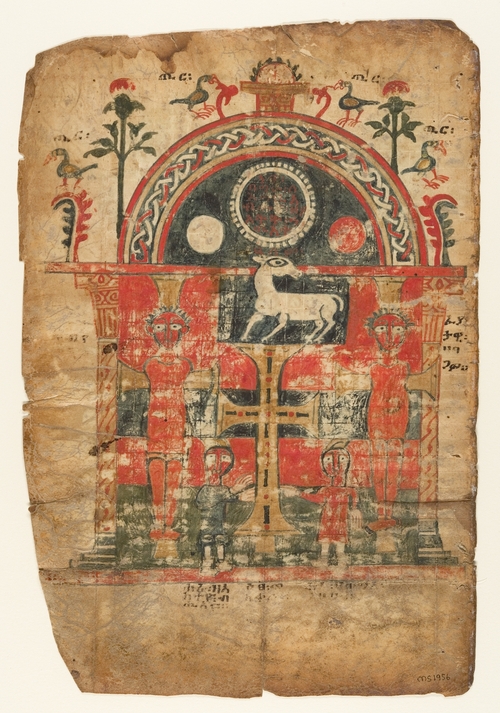
VISUAL THEOLOGY


Double-Sided Gospel Leaf, first half 14th century, Tempera on parchment Overall: 10 15/16 x 7 1/2 in. (27.8 x 19 cm), Metropolitan Museum of Art (New York) ■ The Tigray region of Ethiopia converted to Christianity in the fourth century and became a very important ally of the Byzantine Empire ruled from Constantinople (Istanbul) in controlling the trade routes to India. Tigray also maintained contacts with other Christian communities of the eastern Mediterranean, including those in Syria and Egypt. The compelling images on this double- sided leaf are from a group of early- fourteenth century Gospels that feature a revival of motifs that reached Ethiopia from the eastern Mediterranean, probably in the seventh century. Both sides of the leaf are inscribed in Ge'ez, the ancient language of Ethiopia. On the front is a dramatic octagonal Fountain of Life flanked by peacocks, which are indentified in the inscriptions as "ostriches" (royal birds in Ethiopia), and gazelle like "babula." The text within the domed space refers to the arrangement of the Eusebian Canon Tables, or index to the Gospels, which preceded the image in the original manuscript. On the reverse, the Crucifixion is represented by a monumental jeweled cross topped by a Lamb of God, symbol of Christ's sacrifice. At the sides are the two thieves bound to their crosses. Other leaves from this Gospel are in the Nationalmuseum in Stockholm ■

Second Sunday in Ordinary Time (a)

The poinsettias are gone, the lights are down, the Christmas season is over and now we move on with the very beginning of Jesus’ public life, usually referred to as his ministry, however the great presence of John de Baptist still present. This is the Lamb of God, he said in the gospel[1].

 Lamb of God. We use that term so often that it is easy for us to overlook the deep theology and the tremendous love of our God contained in his sending his Son to be the Lamb.

The first place we come upon the concept of the Lamb of God is in the Book of the Prophet Isaiah and even though this was written six hundred years before Jesus, it describes the feelings of God’s people as they look at Jesus on the cross[2]. He is wounded for our sins, bruised for our iniquities. He has taken upon himself the chastisement that makes us whole. That is how John the Baptist views Jesus when he says, Look, there is the Lamb of God.

The question comes: why? Why did the world need a Savior? Why did God’s son become a man to suffer and die for us? Did the Word have to become Flesh? Was Christmas necessary? Well, we can’t tell God what he can and can’t do, or what is necessary or not necessary. But we can consider this: Jesus came to live as the Father wants us all to live. He sacrificed himself completely for others so that we could experience sacrificial love. He called us to use creation as the Father meant creation to be used.

In the visions of the fifth chapter of the Book of Revelation a book is brought out sealed with seven seals. The book is God’s plan for mankind.  But the plan is sealed.  Who is worthy to open the scroll and break its seals? a voice cries out. But no one in heaven or on earth or under the earth was able to open the scroll or to examine it. The visionary sheds many tears because no one was found worthy to open the scroll or to examine it. But then one of the elders said, Do not weep. The lion of the tribe of Judah, the root of David, has triumphed, enabling him to open the scroll with its seven seals. Only the lamb was worthy to once more restore God’s plan for mankind.

When we say or sing, Lamb of God we are remembering what Jesus did for us and what he has empowered us to do for others. We are remembering his sacrifice to make God’s love real on earth. We are reminding ourselves that joining Jesus in sacrificial love is the only way we can be his followers.

John the Baptist found his reason for existence. He was to point out the Lamb of God to the world. His mission is not different from the mission of every Christian. We are to point out the Lamb of God to the world.

There is nothing greater that any of us can do in our lives than point Christ out to others, first to our children who must follow us in pointing to the Lord for others to find him, and then to all who meet us.

John the Baptist was not a typical person of his time. He was extraordinary. When we consider his life, we realize that it was not John’s dress or preaching that made him extraordinary; it was the fact that he found the purpose for his life. He looked to Jesus and said, There is the Lamb of God. We have been called to do the same ■


[1] Sunday 16th January, 2011, 2nd Sunday in Ordinary Time. Readings: Isaiah 49:3, 5-6. Here I am, Lord; I come to do your will. Ps 39(40):2, 4, 7-10. 1 Corinthians 1:1-3. John 1:29-34.
[2] Who would believe what we have heard? To whom has the arm of the LORD been revealed?
He grew up like a sapling before him, like a shoot from the parched earth; There was in him no stately bearing to make us look at him, nor appearance that would attract us to him.
He was spurned and avoided by men, a man of suffering, accustomed to infirmity, One of those from whom men hide their faces, spurned, and we held him in no esteem.
Yet it was our infirmities that he bore, our sufferings that he endured, While we thought of him as stricken, as one smitten by God and afflicted.
But he was pierced for our offenses, crushed for our sins, Upon him was the chastisement that makes us whole, by his stripes we were healed.
We had all gone astray like sheep, each following his own way; But the LORD laid upon him the guilt of us all.
Though he was harshly treated, he submitted and opened not his mouth; Like a lamb led to the slaughter or a sheep before the shearers, he was silent and opened not his mouth

Desnudo el nuevo Adán, con alma pura
penetra en el Jordán y se sumerge;
se anega en el diluvio del pecado
el que quita el pecado, el Inocente.

Está temblando Juan, tiembla su mano
al tocar la cabeza refulgente;
hoy el siervo bautiza a su Señor,
cumpliendo la justicia que Dios quiere.

Hasta el fondo del ser es bautizado
Jesús, hecho pecado libremente,
y nace del Jordán purificado
el bautismo de fe de los creyentes.

Esa carne divina diviniza,
transforma en sacramento la corriente;
el pueblo renacido en el Mar Rojo
con Cristo canta, libre de la muerte.

Es éste el Hijo amado, el Elegido,
para ungirle el Espíritu desciende;
y de su frente al pueblo redimido
se derrama la unción de aquel aceite.

¡Sea el honor con voz celeste al Hijo
en quien el Padre encuentra su deleite,
a Aquel que hasta el pecado se ha humillado
y con su amor el Padre lo enaltece! Amén
R. Grández, capuchino.
Burlada (Navarra), diciembre 1982

El Bautismo del Señor

Con la muerte de los últimos profetas, se había extendido en el judaísmo tardío el convencimiento de que el pecado de Israel había alejado el Espíritu de Dios de los suyos. Dios guarda un largo y profundo silencio y el pueblo sufre. Los cielos permanecen cerrados e impenetrables. Los hombres caminan tristes a través de una tierra sin horizontes.

La escena del Bautismo de Jesús narrada por los evangelios significa una noticia revolucionaria para los primeros creyentes. El cielo se abre y el Espíritu de Dios desciende de nuevo sobre los hombres. La lección que atraviesa toda la liturgia de éste Domingo es sencilla y fácil de comprender: la vida no es algo cerrado; se nos abre con la presencia del Señor un horizonte infinito.

La Navidad se quedó ya atrás. Muchos nos habremos quedado en la corteza artificial al no profundizar lo suficiente en el misterio, en la gran noticia: el cielo se ha abierto. Dios está con nosotros. Y afortunadamente ésta es la gran verdad que no se termina con estas fiestas. Oculto para unos, desconocido para muchos, Dios está con nosotros. No el dios frío de la razón, no el dios distante del puro misterio, sino un Dios hecho carne, hermano y amigo.

Esta solidaridad de Dios con los hombres pone el cimiento más profundo que podemos concebir a la solidaridad y fraternidad entre los hombres, y la esperanza más viva que puede alimentar la tierra.

Por eso, las luces y estrellas de nuestra navidad no hacen sino iluminar con más fuerza la contradicción en que vivimos tantos cristianos, encerrados en nuestro propio egoísmo, demasiado alejados de un Dios Padre y demasiado extraños a los que no viven para nuestros intereses.

Es fácil cantar villancicos en un hogar caliente y después de una buena cena, a un Jesús de barro. Es más difícil vivir compartiendo lo que uno es y tiene con ese Jesús de carne que son los desheredados de la tierra, aquellos que rechaza la sociedad o “los que no reciben formación” [¡ay desdichada frase!]

La celebración de la Navidad –cuyo ciclo se cierra con esta fiesta del Bautismo del Señor- no es una euforia pasajera entre copas de champán, sino aprovechar el momento para alimentar la alegría interior y la esperanza en la cercanía de un Dios que está presente en nuestro vivir diario. No disfrutando sin límite alguno de los excesos de la sociedad consumista, sino aprendiendo a compartir con sencillez los gozos y sufrimientos de la gente.

Celebramos la navidad trescientos sesenta y cinco días al año siempre que dejamos nacer a Dios en nuestra vida y bautizamos nuestro vivir diario con el Espíritu que animó a Jesús ■ 

VISUAL THEOLOGY


Detalle de la pila bautismal, 
Iglesia parroquial de San Fructuoso, 
La Ojeda (Palencia, España)

Feast of the Baptism of the Lord

And Jesus came upon John baptizing in the Jordan. This was His moment. Jesus would perform an act that would change the course of human history. He did this even though that action would ultimately cost Him His life. Jesus, although infinitely superior to John, allowed John to baptize Him as an expression of His solidarity with all those who were looking to change mankind. From that point on, Jesus became a public person. He would draw the support of thousands and the scorn of the establishment. Eventually, He would be killed, but in the process He would provide life for all who followed Him.  The Easter rites and Orthodox Church are correct in emphasizing the Baptism of the Lord in their celebration of the Epiphany. This is the point in the Lord’s life that Jesus made public the direction his life would take and the death that his decision would lead him[1].

With the billions of people there are in the world, it seems ludicrous for any of us to think that we can make a decision at one point in our lives that will have a tremendous effect upon humanity. But we can. In fact we are called upon as Christians to make a difference in the world. We can take on the action of Christ, and participate in his transformation of the world.

Am I being melodramatic? No, not really. Everyone has benefitted from the determination of others to live and die as Christians. Most of us can say that we are whom we are because our parents made up their minds that they would do everything possible to raise us as Christians. Many of you are sacrificing a great deal of material pleasures because you wanted to bring Christian children into the world. As a result these children have each brightened the world with a unique reflection of Jesus.

You have been and you will be mocked for choosing Christ throughout your life. You went into the Jordan River. But you made the choice to put up with the scorn for the sake of that relationship you have with Christ. Others might laugh at you, but down the road a piece, maybe a long way down the road, that guy or girl might try to be a better person because she or he knew someone who put Christ first in life. That person, those people who mock you now may be people who will chose to be like you later. That is the battle we are in, the Battle for the Kingdom of God.  It is a battle worth fighting, infinitely worth fighting.

John Donne was correct in his poem, “No man is an island.”[2] Everything that we do has an effect upon everyone else. And when we do something extraordinary, we have an extraordinary effect upon others. When we make a critical decision for the Lord, when we decide that we will take a leap outside the status quo of society and plunge into our faith in the Lord, into the Jordan River with Jesus, we effect a tremendous change upon humanity.

The true progress of humanity cannot be measured in terms of technological advances, what we have learned to do. The true progress of humanity can only be measured in terms of ethical advances, how we have learned to behave. When we join Jesus in setting into motion God’s plan for humanity, we help transform mankind from a loose knit group of selfish individuals to reflection of God’s love upon the world.

Jesus saw John baptizing, and knew what he had to do. We have those brief moments of clarity in each of our lives when we can make a difference. We can choose the Lord and go into action. We have to take advantage of the opportunity that is presented to us to join in the development of humanity. “But I’m afraid,” we sob. Hey, suck it up. We have to suck in our stomachs, firm up our shaking knees, as the Letter to the Hebrews says, and be Christians.

The success of our Christian choices is guaranteed by the presence of Spirit. The reward of our choices for the Kingdom is promised by the voice that says, This is my beloved in whom I am well pleased


[1] Sunday 9th January, 2011, Baptism of the Lord. W. Isaiah 42:1-4, 6-7. The Lord will bless his people with peace. Ps 28(29):1-4, 9-10 Acts 10:34-38. Matthew 3:13-17.
[2] John Donne (1572–1631) was an English poet, preacher and a major representative of the metaphysical poets of the period. His works are notable for their realistic and sensual style and include sonnets, love poetry, religious poems, Latin translations, epigrams, elegies, songs, satires and sermons. His poetry is noted for its vibrancy of language and inventiveness of metaphor, especially as compared to that of his contemporaries.

Y entonces uno se queda con la Iglesia, que me ofrece lo único que debe ofrecerme la Iglesia: el conocimiento de que ya estamos salvados –porque esa es la primera misión de la Iglesia, el anunciar la salvación gracias a Jesucristo- y el camino para alcanzar la alegría, pero sin exclusividades de buen pastor, a través de esa maravilla que es la confesión y los sacramentos. La Iglesia, sin partecitas.

laus deo virginique matris


Powered By Blogger